


Trace Fossils
A trace fossil is a type of fossil that records the activity or behavior of an organism, rather than the preserved remains of the organism itself. Examples include footprints, burrows, trails, and even fossilized feces (coprolites).
Over many years, I have built a substantial collection of fossil burrows, some of which reveal remarkable details under microscopic examination. These often contain intricate structures and, on occasion, even microcoprolites. I will include close-up images of selected burrows here; for a more detailed view, please refer to the macroscopy section.
Dinosaur footprints have been discovered at Folkestone within the Greensand beds by S. Friedrich and P. Hadland. These represent the youngest known dinosaur footprints in the United Kingdom. I have not personally observed them, as identifying such traces requires considerable expertise. I will endeavor to obtain permission to share photographs of these footprints in a future update to this site.
On this page you will find some of the better examples in my collection currently. There are many different species to be found at Folkestone. For a better catalogue I recommend a copy of "Fossils of the Gault Clay"


18/01/26
18/01/26
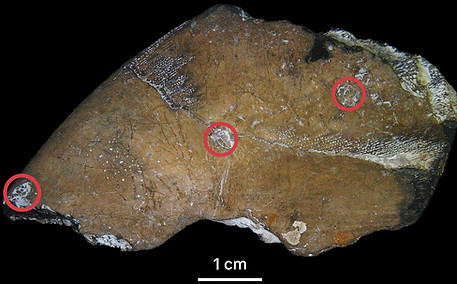
Ischyodus thurmanni - Right mandibular toothplate
This chimaera shark jaw specimen is not only unusually large for a foreshore find, but also represents a significant discovery due to the presence of three clearly visible bite marks attributable to an ichthyosaur.
Based on the observed tooth spacing, the trace maker was most likely Platypterygius campylodon, with an estimated body length of approximately 3–4 meters. It remains uncertain whether these bite marks resulted from scavenging behavior or active predation; expert interpretation and further analysis are welcomed.
Find frequency on the foreshore: Very Rare

Rotularia (Praerotularia) umbonata ?
(J. Sowerby)
Common in occurrence in the gault beds as well at the foreshore.
Can occasionally be found with a slight curve.
Find frequency on the foreshore: Common

Protulophilia gestroi
(Roverto)
The strange patterning on this serpulid worm tube are actually Bioclaustrations caused by a commensal hydrozoan colony, possibly Proboscidactyla.
Find frequency on the foreshore: Uncommon

Unknown
A very strange looking worm tube, I picked it up thinking it was a pathological crinoid only to find once washed it was hollow.
I have not found any other examples, assistance with ID is much welcomed.
Find frequency on the foreshore: Unknown

Glomerula gordialis
(Schlotheim)
Found in almost all gault beds of Folkestone. Measuring on average 2cm. Easily spotted due to the spiral patterning.
Find frequency on the foreshore: Uncommon

Crustacean burrow 1
A large example of the fossil burrows at Folkestone, measuring 6cm long and 3cm wide.
In this image you can clearly see fish scales and possible bone remains. Under closer magnification there are 2 fish jaws and well preserved vertebrae.
For the close up images please see the macrofossil section.
Find frequency on the foreshore: Rare example

Crustacean burrow 2
This specimen is the fossil that started my interest in macro/micro fossils.
On the middle far right you can see a long narrow dark patch. This is actually a fish jaw complete with teeth, the top jaw is also present although worn
For the close up images please see the macrofossil section.
Find frequency on the foreshore: Rare example

Microcoprolites
In my 8 years collecting the foreshore I have only found 2 examples like the above, the pictured is easily the best.
This is a segmented chamber of an ammonite completely filled with microcoprolites.
Find frequency on the foreshore: Very rare

Crustacean Burrow 3
Another very good fossil burrow example, showing 2 fish jaws, unfortunately no teeth are present.
Possible preparation with small dental tools could reveal more detail.
Find frequency on the foreshore: Rare example

Crustacean burrow 4
A very small example of a burrow, measuring at almost 1cm square.
Despite it small size this specimen is packed with fish scales and bones.
Find frequency on the foreshore: Uncommon

Crustacean burrow 5
The above picture shows both sides of a crustacean burrow.
You can clearly see the fish bone and scales on the top side. But on the underside of the right image to the bottom left you can see a clear fish jaw complete with teeth.
Find frequency on the foreshore: Rare example

Crustacean burrow 6
Find frequency on the foreshore: Uncommon

Crustacean burrow 7
The above example is the normal state you will find burrows in the foreshore.
Almost blank and showing few inclusions, but they are always worth picking up to check later. The above specimen as a single inclusion of either a jaw or shark spine.
Find frequency on the foreshore: Common

Crustacean burrow 8
Find frequency on the foreshore: Uncommon

Crustacean burrow 9
This burrow is a rarity in the fact that it not only shows fish remains but also microcoprolites.
If you look to the top left corner you can see banding of black dots, these are often mistaken as brittle star arms but are in fact microcoprolites. Keep scrolling to see a better burrow covered in the bands.
Find frequency on the foreshore: Rare

Crustacean burrow 10
Although this specimen is rather worn, its a great example of the microcoprolite banding you can rarely find in these burrows.
Find frequency on the foreshore: Rare

Crustacean burrow 11
Find frequency on the foreshore: Uncommon

Crustacean burrow 12
Although this example shows a large amount of microcoprolites, they are the more common unbanded example.
Usually found in much smaller burrow or in loose lumps.
Find frequency on the foreshore: Common

Crustacean burrow 13
A small example at only 2cm long, but containing a possible shark spine.
Find frequency on the foreshore: Rare
