


Fossil Shark Teeth
Shark teeth are generally uncommon finds in the sands of Folkestone; however, once one is located, additional specimens often follow.
Most teeth encountered on the foreshore are partial or exhibit some degree of damage, commonly missing side cusps or the tip of the central blade.
On this page you will find some of the better examples in my collection currently. There are many different species to be found at Folkestone. For a better catalogue I recommend a copy of "Fossils of the Gault Clay"


18/01/26
18/01/26
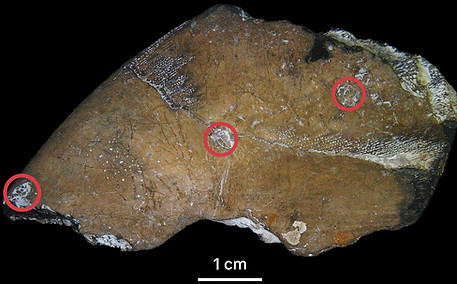
Ischyodus thurmanni - Right mandibular toothplate
This chimaera shark jaw specimen is not only unusually large for a foreshore find, but also represents a significant discovery due to the presence of three clearly visible bite marks attributable to an ichthyosaur.
Based on the observed tooth spacing, the trace maker was most likely Platypterygius campylodon, with an estimated body length of approximately 3–4 meters. It remains uncertain whether these bite marks resulted from scavenging behavior or active predation; expert interpretation and further analysis are welcomed.
Find frequency on the foreshore: Very Rare

Lissodus levis
(Woodward 1887 / Duffin 1985)
Teeth of this shark species are relatively large, typically measuring 10 mm or more.
They are often overlooked, as they are crushing teeth and appear relatively plain to the naked eye. Under magnification, however, fine vertical striae across the enamel become clearly visible.
The illustrated specimen was fortunate to be found with its root intact. It is speculated that some hybodont species resorb the tooth root before shedding, which may explain why most recovered teeth consist solely of the crown.
Find frequency on the foreshore: Rare

Synechodus dubrisiensis
(Mackie 1863)
Teeth of this shark species are small, typically ranging from 5–10 mm.
They are distinctive, with a central cusp flanked on both sides by smaller cusplets. The enamel is smooth, lacking any striations. When collected from sand, these teeth are often broken down to the main cusp and can easily be mistaken for fish teeth.
The illustrated specimen is a well-preserved, complete example. It was collected from Bed VII, extracted directly from the clay through sampling and subsequently washed by another collector.
Find frequency on the foreshore: Rare

Paraorthacodus recurvus
(Trautschold 1877)
This tooth closely resembles those of Synechodus, though it is generally larger, measuring around 15 mm.
It is more robust, with fewer cusplets flanking the central cusp, and displays clear striations when viewed under a microscope.
I have been fortunate to find most specimens largely complete in the sands. Damage, when present, typically consists of a missing cusplet. These teeth are often found with the thick root still attached.
Find frequency on the foreshore: Rare

Protosqualus sigesi
(Cappetta 1977)
These teeth are very small, rarely exceeding 3 mm in length.
The enamel is smooth and lacks striations. They are typically found in good, undamaged condition, likely due to their small, rectangular shape.
I have only encountered these teeth in sand samples examined under a microscope. They appear to be more abundant when collected directly from clay samples.
Find frequency on the foreshore: Rare

Scapanorhynchus praeraphiodon
(Sokolov 1978)
These anterior teeth can reach up to 60 mm in length.
The lingual crown exhibits pronounced striations, while the labial surface remains smooth.
Smaller specimens can easily be mistaken for Carcharias teeth due to their similar appearance.
Find frequency on the foreshore:: Uncommon

Heterodontus canaliculatus
(Egerton and Woodward in 1889)
These teeth are generally small, rarely exceeding 8 mm in length.
The illustrated specimen is a lateral tooth. Due to its diminutive size, it is often overlooked or mistaken for a flint fragment if found without the root.
Under magnification, the enamel reveals intricate detail, with linked, upward-facing ridges extending along its length.
This is the most commonly encountered type of crushing tooth, likely due to the robustness of the tooth structure.
Find frequency on the foreshore: Rare

Carcharias striatula
(Dalinkevicius 1935)
These teeth vary in size from approximately 5–40 mm, depending on whether they are anterior or lateral teeth; most specimens observed range from 5–12 mm.
The anterior teeth feature fine striations on the front surface, while the posterior surface exhibits short vertical folds. The side cusplets are typically slightly curved.
Upper lateral teeth often retain more detailed features along the posterior crown line.
Find frequency on the foreshore: Uncommon

Paranomotodon angustidens
(Reuss 1845)
These teeth can reach up to 20 mm in length.
This species eluded me for many years, but six specimens were discovered in 2024, likely originating from a newly exposed bed higher up the cliff or below the tideline.
The teeth resemble those of Carcharias but can be distinguished by several features: they are more triangular in shape, lack cusplets, and are smooth without striations. Additionally, the enamel of the blade extends fully across the root.
Find frequency on the foreshore: Rare

Cretoxyrhina aff. vraconensis
(Zhelezko 2000)
These teeth are notably large, reaching up to 30 mm.
Specimens found by myself rival some of the larger Dwardius teeth from Folkestone, though they are exceptionally rare—only two have been discovered in eight years of fieldwork.
The teeth feature a wide, nearly flat root with only a slight curvature. The central blade is large and triangular, flanked by a cusplet on each side, which may be either triangular or rounded.
Owing to their size, these teeth are often mistaken for large Cretalamna or Dwardius specimens. It is highly recommended to examine the larger teeth in any Folkestone collection to determine whether one of these rare teeth is present.
Find frequency on the foreshore: Very Rare

Cretalamna appendiculata
(Agassiz 1843)
These teeth are the most commonly encountered in the sands of Folkestone, ranging in size from 5 mm to 30 mm.
Lower lateral teeth are particularly abundant.
Lower lateral teeth are easily identified by their lack of ornamentation and root groove. They possess a large, wide root and a triangular central blade flanked by a cusplet on each side—a classic shark tooth morphology typical of the Gault Formation.
Find frequency on the foreshore: Common

Cretodus semiplicatus
(Münster in Agassiz, 1843)
These teeth range from 5 mm to 10 mm, with lower lateral teeth being the most commonly found.
These specimens are particularly striking, featuring pronounced ornamentation on both the main blade and the cusplets. A distinct root groove is also present, aiding in their identification.
Find frequency on the foreshore: Uncommon

Archaeolamna kopingensis
(Davis 1890)
These teeth are commonly encountered in the sands of Folkestone, ranging from 5 mm to 15 mm in length.
They can sometimes be mistaken for Cretalamna teeth.
The teeth exhibit no ornamentation on either the main blade or cusplets. A root groove is present, and the robust root supports a thin, triangular central blade flanked by widely spaced cusplets on each side.
Find frequency on the foreshore: Common

Dwardius siversoni
(Zhelezko 2000)
Among the lamniform teeth, few rival this specimen in size or prominence.
It is one of the largest teeth found at Folkestone and, due to its rarity, is highly sought after by collectors.
The tooth is similar in shape to Cretalamna but features a much thicker central blade. Both the blade and cusplets display a continuous cutting edge. The root is robust, and some specimens—including the example above—may exhibit double cusplets.
Find frequency on the foreshore: Rare

Leptostyrax sp?
An unusual and immediately recognizable tooth, distinctly different in shape from other teeth found at Folkestone.
Due to the length of the central blade and cusplets, specimens recovered from the sand are often broken.
The tooth features a tall, sharp, and slender central blade with elongated cusplets, giving it a distinctive profile. The posterior surface exhibits subtle raised enamel ornamentation at the base of the crown.
Identification as Leptostyrax is tentative, and it is possible that this classification may be revised.
Find frequency on the foreshore: Rare

Paraisurus macrorhiza
(Pictet and Campiche, 1858)
Specimens I have found range from 5 mm to 15 mm in length.
A distinctive and robust tooth, comparable in sturdiness to Dwardius.
The central blade appears short from the lingual but extends considerably toward the labial. The root is bulbous yet elongated, featuring a narrow triangular gap between the root lobes. The enamel and cutting edge extend along the entire blade and across the root blade, similar to Paranomotodon. Notably, this tooth lacks cusplets.
An exceptionally rare tooth, only two examples are currently in my collection.
Find frequency on the foreshore: Very rare

Squalicorax primaevus
(Dalinkevicius, 1935)
Teeth ranging from 5 mm to 12 mm
Only anterior teeth have been observed by myself.
Anterior teeth are easily identified by their distinctive shape. The blade is curved with a small distal heel, and the cutting edge is unserrated. The root is slightly curved, with one side exhibiting a bulbous profile.
Find frequency on the foreshore: Rare

Ischyodus thurmanni
(Pictet & Campiche, 1858)
Partial dental plates ranging from 3 cm to 8 cm.
To date, I have not found a complete dental plate.
These fossils are very rare on the foreshore and are typically encountered only after storms, when fresh material has been washed out. It is not uncommon to go several years before finding another specimen. When discovered, they are easily recognised, resembling large fish bone with a distinctive dental plate pattern appearing as raised dotting within the bone.
Find frequency on the foreshore: Very Rare

Edaphodon laminosus
(Newton, 1878)
Partial dental plates ranging from 3cm to 8cm
To date, I have not found a complete dental plate; in fact, this is the only example in my collection.
This species is extremely rare and noticeably larger than Ischyodus. It is easily identified, resembling large fish bone with a dental plate pattern raised into the surface, along with an additional curved dental pattern.
Find frequency on the foreshore: Only example I have found

Chimaera vomerine - Elasmodectes sp
(Nessov et al, 1988)
The fossil illustrated above is a vomerine dental plate of a chimaera (ghost shark), specifically the upper vomerine.
This specimen represents the first described example from this locality and is believed to possibly be Elasmodectes kiprijanoffi based on the precense of centrally positioned rows of pleromin rods. This identification is tentative until further material is discovered.
More information on this specimen can be found via the linked publication. Written by C. Duffin and D. Ward.
The specimen is now housed in the Lauer Foundation under the catalogue number LF 7281
Find frequency on the foreshore: Only example I have found