


Fossil Fish
Fish fossils are the most commonly found vertebrate material at Folkestone.
They are mostly encountered as loose teeth and vertebrae, with scales often preserved in fossil burrows.
Complete fish fossils are extremely rare, even when hunting in the clay. More typically, collectors find flanks, skulls, or braincases.
Identifying fossil fish can be challenging, particularly from scales alone, so teeth are usually the most reliable method for species identification.
On this page you will find some of the better examples in my collection currently. There are many different species to be found at Folkestone. For a better catalogue I recommend a copy of "Fossils of the Gault Clay"

Spratticeps gaultinus
(Patterson, 1970)
What you see here is a braincase. Usually found very worn and hard to spot.
This example was freshly washed out of the Gault Clay. I have found these ranging in size from 0.6-1.6cm (the above example is 7mm x 5mm.
I have found 4 of these in 8 years.
Find frequency on the foreshore: Very Rare

Spratticeps gaultinus
(Patterson, 1970)
This example is very worn by the sea and is a good reference of what you will normally find when searching the foreshore.
Find frequency on the foreshore: Very Rare

Apateodus glyphodus?
(Blake, 1863)
As you can see, a very small jaw with two teeth preserved. Identification is a guess on my part. if incorrect please email me and I will amend.
Jaws with attached teeth are rare to find in the sand. Most tend to be worn.
Find frequency on the foreshore: Rare

Protosphyraena sp.
A much larger tooth. Around 2cm in total length although they can come almost double this size.
One of the more common teeth to find in the sands. This is a rare example due to it still being attached to the jaw.
Find frequency on the foreshore: Common

Shark cartilage?
I believe this is fossilized shark cartilage, due to the pattern.
Its not like any fish bone I have come across which tends to be quite flaky and layered. If anyone can confirm it would be much appreciated.
Find frequency on the foreshore: Only piece I have found
.jpg)
Unidentified fish jaw (Gar pike?)
My pride and joy when it comes to my fish jaw's. Only very small measuring 4.5cm in length.
Only when you view it under a microscope do you see its true beauty, a lovely row of teeth although eroded. You can also see along the outline of the jaw extremely small tooth sockets, similar to a modern day Gar Pike.
If anyone has an idea of ID to this specimen please get in contact and I will update.
Find frequency on the foreshore: Very rare

Unidentified fish jaw (Gar pike?)
I believe this specimen represents another example of a gar-pike–like fish jaw.
However, as is evident, the fossil has been rolled extensively by wave action, resulting in significant rounding and surface erosion. This degree of wear obscures many of the finer anatomical details that would otherwise aid in more confident identification.
This specimen displays a similar row of teeth but is again heavily worn. There is no clear evidence of smaller tooth sockets around the rim, which may have been lost due to abrasion
Size of specimen around 3 cm.
Find frequency on the foreshore: Very rare

Belonostomus sp ?
This is the largest fish jawbone fragment I have recovered, measuring nearly 8 cm by 5 cm.
It has been labelled as above due to the presence of large, circular tooth sockets, which are characteristic of certain predatory fish. However, it may also represent Apateodus glyphodus or a species of Lepidotes. Without more complete material, precise identification remains uncertain.
This large specimen clearly displays the typical bone structure seen in fish remains from Folkestone. Fish bone from this locality often appears flaky or layered, reflecting both the original histological structure of the bone and the effects of post-depositional mineral replacement.
Find frequency on the foreshore: Very rare

Apateodus glyphodus ?
I believe this identification to be correct, as the species is described as possessing fang-like teeth. Over eight years of collecting, I have recovered four examples of these teeth, all of which were heavily worn.
In each case, the teeth appeared almost solid, lacking the sharp enamel edges seen in less abraded material, likely due to prolonged exposure on the foreshore.
The specimen illustrated above is relatively large, measuring approximately 2 cm in height. It is a very robust tooth, suggesting it belonged to a predator adapted for seizing or puncturing prey rather than crushing.
Find frequency on the foreshore: Very rare

Spratticepts gaultinus
The specimen shown above is a very rare crushing tooth plate.
This example is small, measuring only 2 cm by 1 cm, and bears minute teeth across its surface. Under magnification, however, the individual teeth reveal remarkable detail, including fine striations and wear facets. Such tooth plates are typically associated with durophagous fish that fed on hard-shelled organisms.
In total, I have found only three specimens of this type over eight years of foreshore collecting, underscoring their rarity at this locality.
Find frequency on the foreshore: Very rare

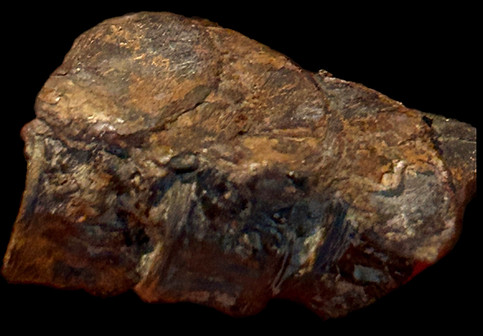
Articulated vetrebrae and large fish scales
This was a particularly unusual discovery, found at the base of the cliffs in freshly washed-out clay. Finds in this context are often short-lived on the foreshore, as wave action can rapidly damage or remove exposed material, making timely collection essential.
The fossil itself is relatively small, measuring approximately 3 cm by 2.5 cm. The most striking feature is that the scales are almost twice the size of the attached vertebrae. This disproportion is unusual and may reflect either taxonomic characteristics of the species or differential preservation of skeletal elements. Such features may prove useful in aiding identification by a specialist.
I am confident that this observation will assist an expert in determining the identity of the specimen. If anyone is able to confirm an identification, I would welcome further information so that this record can be updated accordingly.
Find frequency on the foreshore: Only piece I have found

Fish vertebrae in phosphatic nodule
In the example shown above, one of the common phosphatic nodules from Folkestone can be seen containing two large fish vertebrae and two large fish scales.
Each fossil measures approximately 1.8 cm across, indicating that they originated from a relatively large fish. Phosphatic nodules often act as natural protective capsules, preserving fossils in three dimensions.
Unfortunately, the phosphatic nodules of Folkestone are notoriously difficult to prepare. The pale outer coating is typically only around 0.5–1 mm thick before giving way to dense black phosphate beneath. This material is extremely hard, and attempts at preparation frequently result in damage or shattering of the enclosed fossil rather than successful exposure.
Find frequency on the foreshore: Loose vertebra are common, multiple in a nodule are rare

Squatina sp vertebra
The specimen illustrated above is a large shark vertebra, most likely belonging to a ray-type shark based on its squat, disc-like shape.
Cartilaginous fish vertebrae are significantly less common than bony fish vertebrae at this locality, making such finds noteworthy.
This example is unusually large and well preserved for a foreshore find, measuring approximately 3 cm across. Its condition suggests it was recently eroded from the clay cliffs rather than having been subjected to prolonged wave action.
Find frequency on the foreshore: Uncommon

Squatina sp vertebra
Similar in overall shape to the previous specimen, this example is more typical of what is commonly found on the foreshore. The surface shows clear signs of abrasion, indicating long-term exposure and transport by the sea.
As can be seen, the specimen has been heavily worn and eroded, confirming that it has been out of its original matrix for an extended period. Such wear often removes fine surface details, making precise identification more difficult.
Find frequency on the foreshore: Uncommon