


Fossil Urchins, Starfish, Crinoids & Brittle stars
Urchin (echinoid) fossils are abundant in certain beds at Folkestone. During my first year of collecting, significant clay falls from the cliffs yielded several well-preserved specimens. Over the past six years, however, this clay has been eroded away, and most urchin finds are now limited to isolated spines or, more rarely, complete individuals from the Greensand beds.
Complete starfish and brittle star specimens are extremely rare. I possesses only a small partial brittle star arm. Starfish segments, measuring between 3 mm and 0.1 mm, can occasionally be recovered from fine sand samples, though they remain uncommon.
Crinoids, in contrast, are highly abundant at the foreshore of Folkestone, and likely even more so within the in-situ beds. I have never visited the site without finding at least one segment—proof that they are among the most reliably encountered fossils for those who search diligently.
Urchins, starfish, brittle stars, and crinoids all survived the Cretaceous–Paleogene extinction event and continue to thrive in our oceans today—remarkably resilient and enduring creatures.
On this page you will find some of the better examples in my collection currently. There are many different species to be found at Folkestone. For a better catalogue I recommend a copy of "Fossils of the Gault Clay"

Hirudocidaris uniformis
(Schlüter, 1892)
The urchins of Folkestone are most readily identified by the distinctive structure of their spines.
The specimen illustrated above displays spines with a finely serrated, rib-like pattern, separated by deep grooves.
This type of spine is relatively uncommon in the sands, and I have as yet to encounter a complete specimen.
Find frequency on the foreshore: Uncommon

Prionocidaris neglecta
(Smith & Wright, 1989)
The urchins of Folkestone are most readily identified by the distinctive structure of their spines.
The spine illustrated above is more slender than that of H. uniformis and features fewer serrated ribs. Unlike H. uniformis, there is no deep groove separating the ribs.
This type of spine is relatively uncommon in the sands, and I have as yet to encounter a complete specimen.
Find frequency on the foreshore: Uncommon


Allomma rhodani
(Agassiz, 1840)
Urchins from Folkestone are often most readily identified by the characteristics of their spines rather than the test itself. In many cases, spines are more robust and survive transport and erosion better than the body of the animal.
The spines of this particular species are extremely long and thin, lacking any surface ornamentation. Their delicate form suggests a specialised function, possibly related to stabilisation within soft sediment.
To date, I have never encountered loose spines of this type in the sand, indicating that they are either rarely preserved once detached or are usually lost during erosion and transport.
The illustrated specimen was discovered approximately seven years ago within a block of fallen clay. Although most of the test is absent, the long, slender spines remain attached, offering a rare opportunity to study spine arrangement and morphology. The specimen is currently with a specialist for preparation, with the hope that further anatomical details may be revealed once excess matrix is removed.
Find frequency on the foreshore: Not seen

Hemiaster cossignyi
(Lambert, 1994)
This urchin species is typically found without spines, often crushed or flattened within the clay beds.
It is easily recognized by its distinctive heart-shaped test.
The illustrated specimen was discovered in a lump of fallen clay around 7 years ago. As expected its in poor condition and squashed as is usual from the clay. Photo supplied for reference.
Find frequency on the foreshore: Uncommon

Hemiaster cossignyi
(Lambert, 1994)
This urchin species is typically found without spines, often crushed or flattened within the clay beds.
It is easily recognized by its distinctive heart-shaped test.
The illustrated specimen was discovered in an eroded clay fall. Despite its small size, it is relatively heavy, likely due to pyritization. The body shape is well-preserved, with the detailed petal structures clearly visible.
Find frequency on the foreshore: Uncommon

Phylobrissus cercelleti
This urchin species is found without spines, usually crushed or flattened within the Greensand bed.
Often found either as a partial fossil or very rarely like the above complete but with matrix still attached. Usually discovered after rough stormy seas.
This species is much smaller than the Pseudholaster cantianus at only around 3-6cm.
Find frequency on the foreshore: Rare

Pseudholaster cantianus
This urchin species is found without spines, usually crushed or flattened within the Greensand bed.
Often found either as a partial fossil or like the above complete but covered in matrix. Usually discovered after rough stormy seas.
Find frequency on the foreshore: Rare

Camerogalerus cylindricus
(Dixon, 1850)
The test is notably cylindrical in shape and it has a high profile. Bottom surface us characteristically planar.
Sizes usually range around 3.5cm across. The above example is 2.8cm.
To my understanding this echinoid has not been described at Folkestone. This example was found by another collector just past the Warren and is solid pyrite inside the test. Advice is welcomed.
Find frequency on the foreshore: To my knowledge, only one known

Ophiomusium sp.
The photo above features the partial arm of a brittle star. These are very rare in the sands of Folkestone, I have not heard of a complete specimen.
Most finds are either as you see above or single segments of the arm. I know of one example of a longer length of arm within greensand matrix found by P. Mannering-Green.
Find frequency on the foreshore: Very rare

Zoroasteridae indet.
The above naming of the photographed specimen is not definite, more research is required. Due to the small segments of the specimens found 01-.2mm.
The photo above features the terminal ossicle of a starfish. These are very rare in the sands of Folkestone, I found this example going through a sand sample under the microscope
Find frequency on the foreshore: Rare
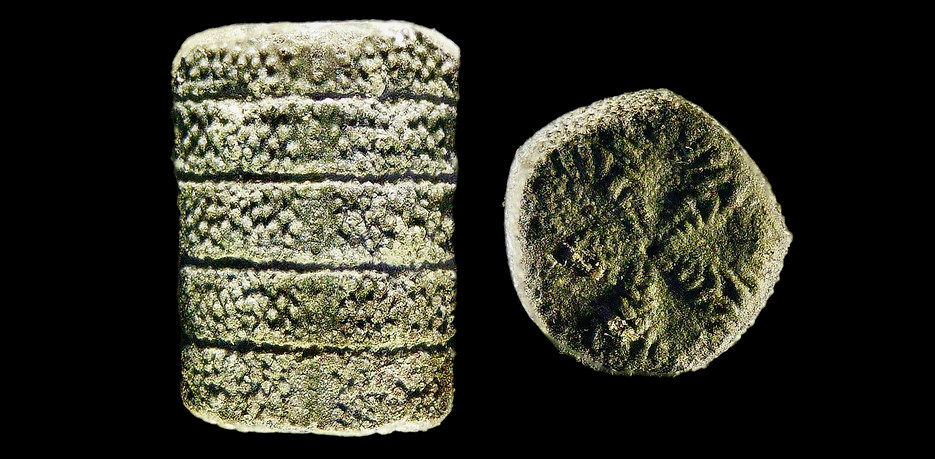
Isocrinus legeri
(Repelin, 1899)
Very easy to spot within the sands. Crinoids at Folkestone have a distinct star shape, the isolated ossicles used to be referred to as "fairy money" as it was believed to be the currency of the mythical beings.
I have not yet found the connecting bodies (calyx) of crinoids in the sands, its possible they are able to be found in the clay beds but its not something I can confirm.
The above example has the expected 5 point symmetry with beautiful detail. They also have very fine granular banding when viewed under a microscope.
Find frequency on the foreshore: Uncommon

Isocrinus cenomanensis
(d'Orbigny, 1850.)
Very easy to spot within the sands. Crinoids at Folkestone have a distinct star shape, the isolated ossicles used to be referred to as "fairy money" as it was believed to be the currency of the mythical beings.
I have not yet found the connecting bodies (calyx) of crinoids in the sands, its possible they are able to be found in the clay beds but its not something I can confirm.
The above examples have the expected 5 point symmetry with beautiful detail. Unlike I.legeri this species does not have any granular banding and is smooth.
Find frequency on the foreshore: Common
