


Ammonites & Heteromorphs
Now we come to the fossils that make Folkestone famous: Ammonites. On every visit, you are almost guaranteed to find at least partial specimens. The site is incredibly rich, with some ammonites appearing quite similar while others are wildly different. Fresh examples from the clay can feature beautiful pearlescent colors, ranging from green and pink to, in rare cases, blue.
The easiest way to distinguish an ammonite from a heteromorph is by shell shape. An ammonite has a coiled shell, somewhat like a snail, whereas a heteromorph is an uncoiled variant.
Although it’s easy to mistake ammonites for snails due to their shell shape, they were actually cephalopods. I often describe them as “a squid wearing a hat.”
The closest living relative today is the nautilus. It is believed that nautili survived the Cretaceous extinction by dwelling in deeper waters, whereas ammonites and heteromorphs preferred shallower waters. This also explains why nautilus fossils are far rarer at Folkestone.
As a foreshore collector, most of my ammonite finds are damaged and non-pearlescent, but they are invaluable for training your eye to recognize the shapes and features you’ll need to spot in the field.
On this page you will find some of the better examples in my collection currently. There are many different species to be found at Folkestone. For a better catalogue I recommend a copy of "Fossils of the Gault Clay"

Pseudhelicoceras pseudoelegans
(Spath, 1936)
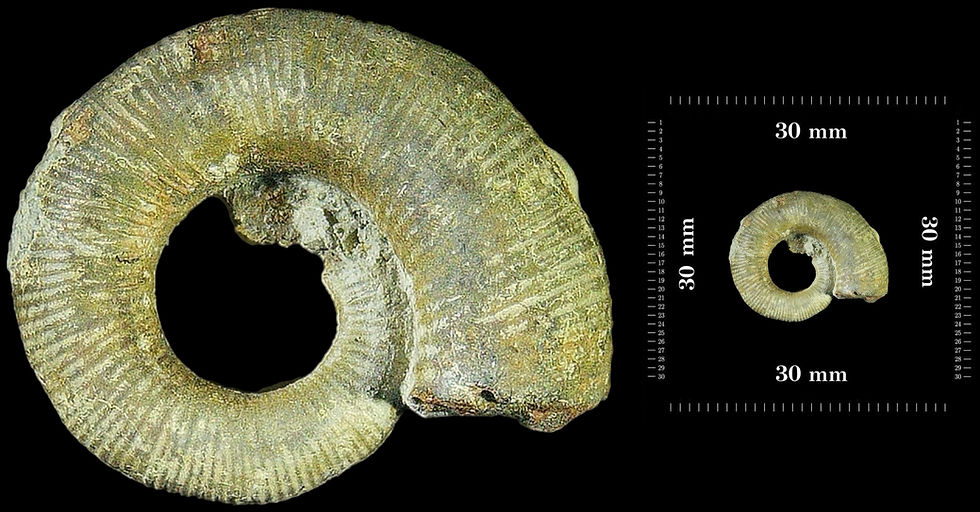
Eoscaphites circularis
(Spath, 1936)

Hysteroceras orbignyi
(Spath, 1922)

Euhoplites nitidus
(Spath, 1925)

Euhoplites loricatus
(Spath, 1928)

Euhoplites vulgaris
(Spath, 1930)

Euhoplites truncatus
(Spath, 1925)

Euhoplites proboscideus
(J. Sowerby, 1821)

Epihoplites denarius
(Spath?)

Dimorphoplites chloris
(Spath, 1924)

Euhoplites bucklandi
(Spath, 1925)

Anahoplities

Idiohamites tuberculatus
(J. Sowerby, 1818)
